Data centers are evolving rapidly to meet a dual challenge: delivering greater capacity and performance for businesses and artificial intelligence, while at the same time reducing their energy footprint. In an increasingly digitalized environment, these infrastructures have become essential to organizational operations, hosting the systems that process, store and distribute vast volumes of information.
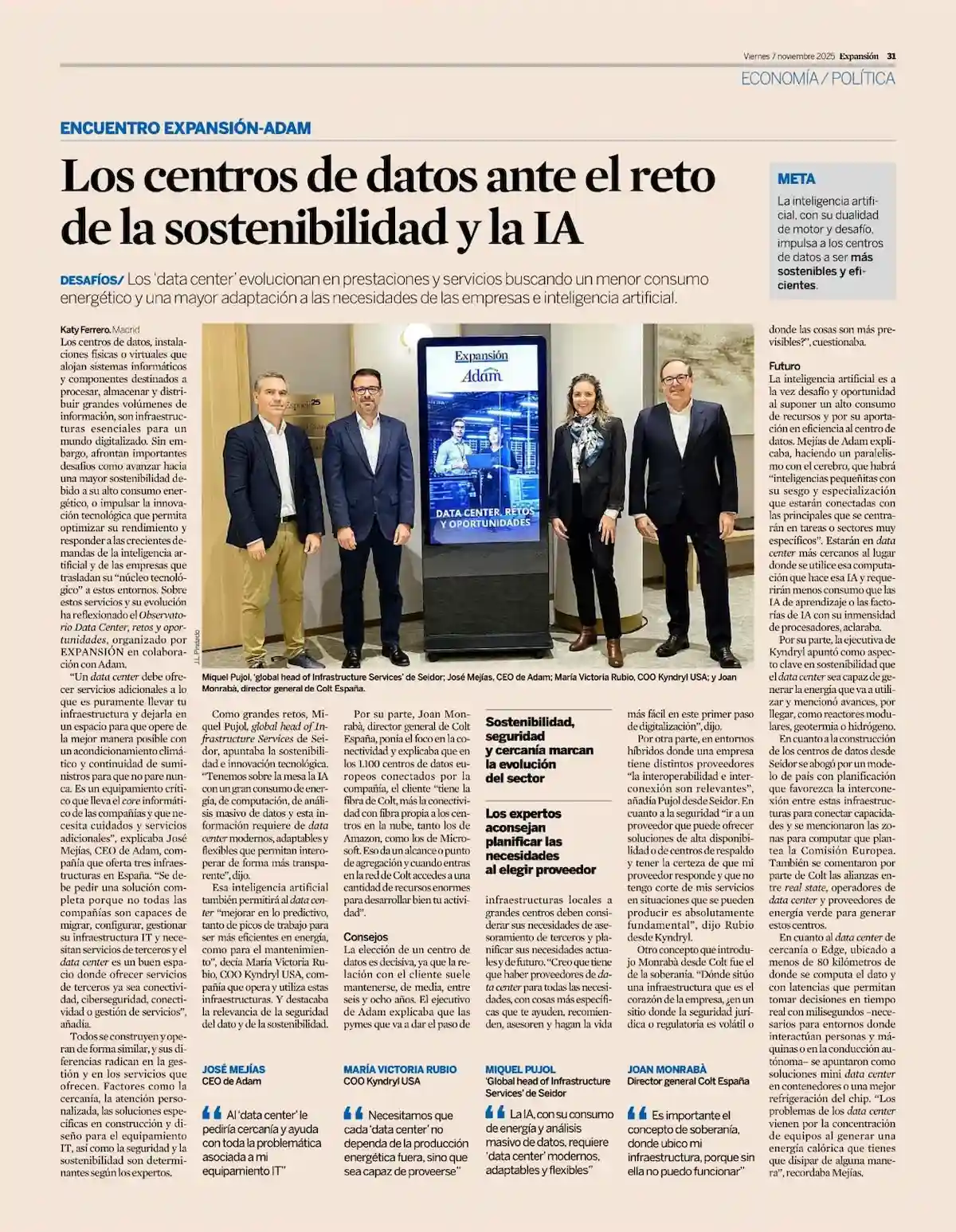
Against this backdrop, Adam co-organized with EXPANSIÓN the event Data Center Observatory: challenges and opportunities (article by Katy Ferrero), a forum for reflection where industry experts discussed how data centers must evolve to remain efficient, sustainable and aligned with the real needs of businesses.
Beyond physical space: services, proximity and ongoing support
One of the key takeaways from the event was that a data center can no longer be limited to providing space, cooling and power continuity. As explained by José Mejías, CEO of Adam, these facilities host the technological core of companies and therefore require a much more comprehensive approach:
“A data center must offer services beyond simply hosting infrastructure. It is critical equipment that supports the IT core of companies and requires additional care and services.”
Mejías highlighted that many organizations lack the internal resources to migrate, configure and manage their IT infrastructure. As a result, data centers become an ideal environment to deliver complementary services such as connectivity, cybersecurity or managed services, enabling genuine support throughout the digital transformation process.
While data centers share a common technical foundation, experts agreed that real differentiation lies in management and service offerings. Factors such as proximity, personalized attention, IT-specific design, security and sustainability—core pillars of Adam’s approach—are decisive when selecting a provider.
AI, sustainability and innovation: the sector’s main challenges
Artificial intelligence was one of the central themes of the discussion. Miquel Pujol, Global Head of Infrastructure Services at Seidor, pointed out that AI presents a major energy and technological challenge:
“We are facing AI with very high energy consumption, massive computing and data analysis requirements, which demand modern, adaptable and flexible data centers.”
From an operational standpoint, María Victoria Rubio, COO of Kyndryl USA, explained that AI itself will help improve data center efficiency, both in predicting workload peaks and in maintenance, while also stressing the importance of data security and sustainability.
Connectivity also played a prominent role. Joan Monrabà, Managing Director of Colt Spain, emphasized interconnection capabilities as a key value for customers, explaining how a network of interconnected data centers allows access to multiple cloud and technology resources from a single aggregation point.
Choosing the right data center: a long-term strategic decision
One of the most relevant messages from the event was that choosing a data center is a long-term strategic decision: the relationship between customer and provider typically lasts between six and eight years.
In this regard, José Mejías advised companies moving from on-premise infrastructure to professional data centers to plan both their current and future needs, and to assess the level of advisory support they will require.
The discussion also highlighted the importance of interoperability in hybrid environments, high availability and backup data centers as critical elements for ensuring business continuity. In addition, the concept of data sovereignty emerged, understood as the need to locate critical infrastructure in environments with legal and regulatory stability.
The future: edge computing, efficiency and new energy models
Looking ahead, AI is shaping up as both a challenge and an opportunity. Mejías compared its evolution to that of the human brain, pointing to a future with specialized intelligences closer to where computing is used, with lower energy consumption than large-scale AI factories.
In terms of sustainability, several advances were mentioned, including:
- on-site energy generation
- modular reactors
- geothermal energy
- hydrogen
- and the need for territorial planning that encourages interconnection between data centers
The role of edge data centers was also discussed, highlighting proximity-based infrastructures capable of delivering millisecond-level latency for real-time use cases.
Driving dialogue to build more responsible infrastructures
Co-organizing this observatory with EXPANSIÓN reinforces Adam’s commitment to creating spaces for analysis and dialogue with key players in the technology ecosystem.
Sharing perspectives, anticipating trends and debating sustainability, AI and proximity are essential to building a data center model that is more efficient, responsible and aligned with business needs.
At Adam, we continue working to ensure that technological innovation and environmental commitment advance hand in hand, delivering critical infrastructures that support our clients today and in the future.
📹 Watch the video with insights from the industry leaders who participated:

This article has been written by
Adam